South Korea

login to the site


Sightseeings
Seoul is the capital of the republic
Airport in Incheon
Cities of South Korea
Jeju Island (Jejudo)
Korean food
Koreans
State
 Flag of the Republic of Korea
Anthem of the Republic of Korea
Armed Forces of the Republic...
Money in South Korea
Korean War
"Foreigners" in Korea
Books about Korea and Koreans
Your search queries
Travel and impressions
Hotels in Korea
Flights to Korea
Bibliography
News
Flag of the Republic of Korea
|
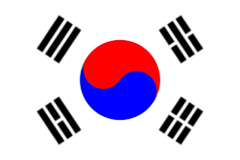
Let's emphasize from the outset that the flag of the Republic of Korea stands out among all modern flags for the complexity of its symbolism and the depth of meaning conveyed by it. The only easily described feature is the flag's background. The white background is the national color of Korea ("a nation in white"), symbolizing light, purity, and peacefulness.
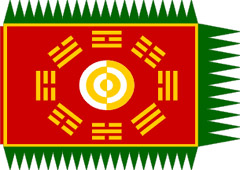
The flag's complexity is likely due to the fact that the obligatory triad of state symbols ( anthem , coat of arms, and flag) did not exist in national Eastern traditions; they were imported from the West. Therefore, the Korean flag did not emerge through traditional means, but only when a "diplomatic" need arose. It was literally "invented" in the late 19th century by national intellectuals. Although, of course, the symbolism it uses is traditional and local, or rather, imported from neighboring China. However, such "invention" of flags has also been seen in Western countries; for example, the flag of Norway, according to one theory, was drawn by a child after all attempts by "professionals" were deemed unsuccessful. However, an image of an older (possibly ancient) Korean flag can be found online, which could be considered a prototype for the modern flag. However, we were unable to find reliable information about this image. If you have any information, we would be happy to add to this article.
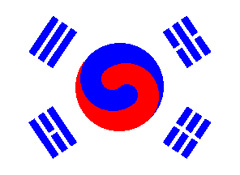
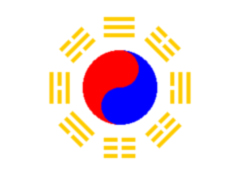
According to one theory, the need for a national flag was first raised in Korea in 1880, but the actual design wasn't created until 1882, when a Korean delegation led by the renowned (then still very young) Korean politician Park Yong-hyo traveled to Japan for negotiations. The flag was allegedly painted directly on the ship when its necessity for diplomatic protocol became apparent. It's unclear whether Park Yong-hyo was the sole author of the flag, as the extent of the then-reigning King Gojong's involvement in its creation is unclear. Another theory holds that Park Yong-hyo consulted extensively with the captain of the English ship that carried the Korean delegation to Japan. According to this theory, it was the British captain who recommended simplifying the flag by reducing the number of trigrams used from eight to four. An image of this first Korean flag, from 1882, can be found online. It should be noted that, unfortunately, there is no absolute certainty that the flag actually looked like this. The fact is that King Gojong, when he issued a special decree approving the flag on March 6, 1883, for some reason did not accompany it with a detailed description of the new national symbol. Moreover, there are sources claiming, for example, that the royal representative office in Hamburg in 1893 used a slightly different flag with the full number of trigrams (eight).
However, there is a slightly different view on the history of the Korean flag. According to this version, its design was actively discussed with the Chinese long before Park Yong-hye's mission (China's influence on Korea was very strong at the time). Chinese experts recommended adopting a flag similar to the Chinese flag of the time, with a dragon on a yellow background, replacing the yellow with blue. However, the Koreans rejected this design as "too sophisticated." Later, in 1882, the flag issue was raised again during Korean-Chinese negotiations, and Chinese representative Ma Ching-chung proposed using the "Yin-Yang spiral" in a red and blue version and the eight trigrams. He justified his proposal by citing the eight provinces of Korea and the fact that red is the color of royalty and blue that of the common people.
One version agrees: the reduction of the trigrams from eight to four occurred during the aforementioned diplomatic mission of Park Yong-hyo on an English vessel, with the participation of the English captain James. After the 1883 decree, the flag remained the national flag until 1910, when Korea was annexed by Japan and lost its independence. After Korea's liberation and its division into two zones of influence, the flag regained its official status. As early as 1942, the Korean "government in exile" declared the "return" of the national symbol. Both divided Koreas used it until the fall of 1948, when North Korea adopted its own flag.
So, in the center of the flag is a circle with the Eastern symbols of Yin (eum in Korean) and Yang, well-known in our country. However, we are more accustomed to a slightly different representation of this symbolism – black and white, rotated ninety degrees, with additional black and white dots on the corresponding "drops." The blue and red drops, symbolizing two opposing yet united energies of the world, merge in a single vortex, forming the circle of the Great Beginning – Taegeuk. The word "flag" in Korean is "ki," which is why the Korean flag is called Taegeukki. The symbolism of the Great Beginning or the Great Limit came from China. The red drop, representing Yang energy, represents the top, hardness, fire, masculinity, heaven, etc. The blue drop, representing Yin energy, represents the bottom, softness, water, femininity, earth... Closer to the corners are four trigrams, each consisting of three black stripes of two different types—broken and solid. The stripes were described in the famous Chinese "Book of Changes" and are also symbols of Yang (solid) and Yin (broken) energies.
There is a lot to say about these stripes. There are several different arrangements of the trigrams, and the relationship between these symbols and other categories of Chinese philosophy is well known. There is even a mention of them inspiring Leibniz to create the binary number system. In addition, trigrams (Korean: kwe) served as the basis for constructing the Korean national alphabet "onmun". And on the flag of the Republic of Korea they represent the following (starting with the three Yang stripes in the upper right corner and continuing clockwise): the trigram Qian (three solid Yang, Chinese - Qian) is associated with such concepts as heaven, father, fortress, creativity, south and summer; Kam (Yin-Yang-Yin stripes, Chinese: Kan) - the moon, west, immersion, danger, middle son, autumn and water; the trigram Kon (three Yin, Chinese: Kun) - earth, mother, dedication, fulfillment, north, winter; Li (Yang-Yin-Yang, Chinese: Li) – sun, east, cohesion, clarity, middle daughter, spring, fire. The black color of the trigrams symbolizes vigilance, fortitude, justice, and chastity.
Overall, the flag symbolizes the nation's development in complete harmony with the universe: balanced dynamism, unity, completeness, and the interdependence of opposing forces and principles in the cosmos. Suggested associations: peace, unity, hope, creation, and infinity.
The following flag parameters are also standardized: the length-to-width ratio must be 3:2, the pommel must depict the bud of the national flower, mugunghwa (hibiscus, rose of Sharon), and be painted gold, with the lower portion of the pommel depicting a five-leafed calyx. The flagpole may be made of any durable material, but the pole must be painted the same color as bamboo or a similar shade. |
|