South Korea

login to the site


Sightseeings
 Bulguksa Temple
Ulgi Park
Yomiji Botanical Garden
Cheomseongdae Observatory
Gyeonggi National Museum...
Thumuli Park (Daereunwon) in...
Yongdusan Park in Busan
Seoul is the capital of the republic
Airport in Incheon
Cities of South Korea
Jeju Island (Jejudo)
Korean food
Koreans
State
Korean War
"Foreigners" in Korea
Books about Korea and Koreans
Your search queries
Travel and impressions
Hotels in Korea
Flights to Korea
Bibliography
News
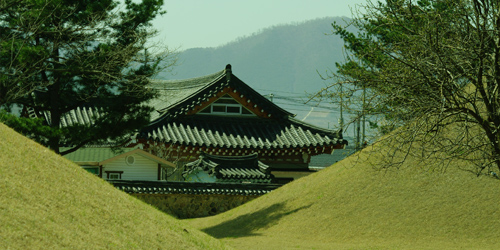
Bulguksa Temple
Beginning in the sixth century AD, Buddhism became the official religion of the Silla state (also known as Shilla in Russian literature). Active construction of temples, monasteries, and pagodas began. The construction of the Bulguksa Temple in Gyeongju dates back to this time . This word can be translated from Korean as "Temple of the Land of Buddha" or "Land of Happiness." Since then, the temple has been destroyed, burned, and then rebuilt so many times that only stone fragments may remain of the original structures. It is known, for example, that the temple was completely destroyed during the Imjin War with Japan in 1593. What can be seen today is the result of the monastery's final restoration in the early 1970s, carried out under the personal orders of then-Korean President Park Chung-hee. Only the main buildings were restored; the ancient temple complex was much larger, comprising approximately 80 structures. Even what has been reconstructed leaves an unforgettable impression.
Many beautiful legends are told about the temple. One of them concerns its first builder, Kim Dae-sung (or, in another transcription, Kim Tae-sung). According to legend, the construction is connected not with one, but with two of his lives, in accordance with the Buddhist concept of reincarnation. The legend goes that a farmer named Kim Dae-sung worked long and hard to support himself and his widowed mother. As a result of his diligent work, he finally managed to save up for a small plot of land. But when a monk came to the village seeking donations, Kim Dae-sung donated his land to the monastery. Some time later, he died, and on the day of his death, the Prime Minister of Silla heard a voice from heaven announcing the birth of a son, Dae-sung. The son was indeed born, bearing a birthmark in the shape of the Chinese character "Dae-sung." As the child grew older, many miraculous stories befell him. One of them is about a bear he killed, and then, when the bear's spirit decided to take revenge on him, he promised to build a temple in its honor. He did so, thus gaining experience in temple building even before becoming a Buddhist. When he converted to Buddhism, he used this experience to build two temples at once: the Seokguram Cave Temple, in honor of his parents from his previous life (in which he was a farmer), and the Bulguksa Temple, in honor of his parents from the life he was living then. Thus, both of these temple complexes, located close to each other, symbolize filial gratitude and love. Interestingly, they are also included in the UNESCO World Heritage List together, as a single entry. Moreover, as of this writing, they are the only ones in South Korea to be included on the list under the first of the accepted 10 criteria: as masterpieces of human creative genius.
The gates to the temple complex are "guarded" by four brightly painted wooden giants—one for each cardinal direction. Beyond the gates lies a stream, and across it is a bridge, which in Buddhism symbolizes the transition between the secular world and the world of Buddha. The stream flows from a pond, associated with another beautiful legend.
To build the pagoda tower at Bulguksa Temple, the stonemason architect Asadal was brought from China. The master was separated from his young, beloved, and beautiful wife, but he embraced his new work as his life's work and devoted himself entirely to it. Some time later (some say a year or even several years), the longing wife came to Silla to find her husband. She reached Bulguksa Temple, but the guards refused to let her through the gates. Perhaps because women were forbidden to enter the temple grounds at the time, or perhaps simply because the work was not yet finished. Seeing the woman's sincere sadness, they advised her to observe the progress of the pagoda construction by observing its reflection in a nearby pond. Young Asanyo spent all her time by this pond, trying to discern her husband and the pagoda he was building in the reflection. Gradually, the mirror of the pond became more real to the woman than the surrounding world, but only one tower, already built, was reflected in the water. It is said that one day she finally saw her husband's reflection in the water, but mistook the second pagoda, the fruit of his labor, for another woman. In despair, Asanyo plunged into the pond and drowned. Others say she waited so long for her husband that she lost her temper and jumped into the pond as soon as she saw his reflection. In any case, when Asadal learned of his wife's arrival, she was already dead. He searched for Asanyo for a long time in the vicinity of the temple, although locals told him of the tragedy. One day, he thought he saw his wife standing near a tree. He ran up to her, but saw only a large, upright rock. A stonemason decided to carve a figure of his wife from this rock, but when the work was completed, a Buddha emerged instead. This Buddha, created by the architect, still stands on the eastern side of Yongji Pond.
Two ancient stone pagodas, symbolizing Yin and Yang, are located within the Bulguksa Temple complex and are listed as National Treasures of the Republic of Korea. The three-tiered, over 10-meter-tall Dabotap Pagoda, symbolizing the beginning of Yang, has a highly complex, unique form. This pagoda is completely unlike similar structures of its time, with its intricate ornamentation and sculptural technique. Dabotap is translated as "abundance of treasures" or "pagoda of numerous treasures." It is one of the symbols of Korea; its image is even minted on the 10-won coin . There is evidence that the tower was dismantled by the Japanese, and some speculate that the tower actually contained objects (treasures?) that were taken from Korea. Indirect confirmation of this hypothesis is the fact that when looters blew up the second pagoda (Sokkathap) in 1966 during its reconstruction, many ancient objects were indeed found inside, including a scroll with text and wooden printing blocks, apparently the oldest discovered in the world to date. The Tabothap Pagoda was "guarded" by four stone lions, but only one survives. The second is in the British Museum in London, and rumors circulated about the remaining two, which were seen in a Tokyo restaurant in the early 20th century. However, the extent to which these rumors are true is unknown.
The second pagoda, Sokkathap, is shorter than the first (about 8 meters) and simpler in design, practically devoid of any additional decoration, but its perfect, harmonious proportions are a delight to the eye. Sokkathap is translated as "stupa containing the remains of Buddha Shakyamuni." After the explosion in 1966, looters were unable to steal the items inside: monks awakened by the explosion prevented them. This is the very pagoda whose completion the unfortunate beauty Asanyo awaited. For this reason, it is sometimes called the "pagoda that casts no shadow."
In fact, the Bulguksa Temple grounds are filled with many cozy, exceptionally beautiful spots. Nature here harmonizes beautifully with human creations. This is truly an iconic place in Korea, and a visit to it is included in the vast majority of tourist tours. A visit here is incomplete without a visit to Korea.