
South Korea

login to the site


Sightseeings
Seoul is the capital of the republic
Cheonggyecheon Stream
 Gyeongbokgung Palace
N Seoul Tower. N Se...
Airport in Incheon
Cities of South Korea
Jeju Island (Jejudo)
Korean food
Koreans
State
Korean War
"Foreigners" in Korea
Books about Korea and Koreans
Your search queries
Travel and impressions
Hotels in Korea
Flights to Korea
Bibliography
News
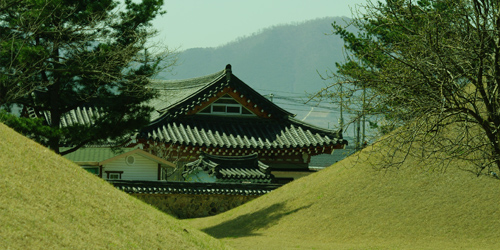
Gyeongbokgung Palace

Let's start, as usual, with the name. " Gyeongbokgung Palace " sounds about as incorrect as "Jeju Island," since "kun" is the Korean word for palace. So, it would be more accurate to say Gyeongbok Palace or simply Gyeongbokgung . The word Gyeongbokgung is translated into Russian in various ways. You often hear the translation "palace of sunlight and happiness," but we prefer the shorter and more expressive version, "palace of radiant happiness." Yes, they know how to name it in the East!
Gyeongbokgung Palace (Kyongbokkung) is the largest of the five great palaces built during the Joseon Dynasty, covering a total area of 410 square meters. The changing of the guard of the royal guard is regularly held here—a beautiful spectacle that invariably attracts tourists. A Russian television program recently claimed that Korean military personnel invariably participate in this performance. However, they say these are mostly the children of high-ranking parents who don't want to serve in more distant and dangerous locations. Perhaps, although I'm not certain, "dodging" military service in South Korea is far from typical and not encouraged by society, as the country is still technically at war.
A guard stands at the three-doored Gwanghwamun Gate . Only the king himself could enter through the central door, while high-ranking officials entered through the two side doors. This gate has an interesting history. During the Japanese annexation, it was rebuilt, like the rest of the palace, in 1860 and moved to the palace's eastern wall. Then, during the Korean War, it burned down. Only in 1968 was it fully restored and moved to its original location. It is said that the President of the Republic of Korea personally inscribed the name of the gate in Korean; previously, it was in Chinese.
Gyeongbokgung Palace is located at the northern end of Seoul's central thoroughfare , Sejongno Avenue. The palace is said to have been built in 1394 by the Korean architect Jeong Do-jeon under the orders of King Taejo Wo, the founder of the Yi dynasty. In 1592, during the war with Japan, the palace was burned and destroyed. Guidebooks, however, claim that in this case, it wasn't the Japanese who were to blame for the palace's destruction, but rather the locals themselves, outraged by the government's sudden flight. For 273 years, the site lay abandoned, the royal court moving to Changdeokgung Palace. It wasn't until 1865, during the reign of King Gojong, that the palace was rebuilt. It became the residence of the Korean emperor until 1895, when, shortly after the assassination of Queen Min (also known as Empress Myeongseong, who pursued a pro-Russian political line) by Japanese agents, her husband, Emperor Gojong, left Gyeongbokgung.
In the 20th century, during the Japanese occupation, only ten of the 330 buildings were left standing; the rest were demolished. However, only the main buildings remained. One of the two main buildings in the complex is Geunjeongjeon , or Kunjongjeon , the imperial throne room. Korean monarchs were crowned here and conducted state affairs here. Restoration work on the building was recently completed. Approximately $6 million was allocated for the restoration work, which lasted nearly four years. During the major renovation and restoration of Geunjeongjeon, all four load-bearing columns were replaced, the second floor was completely rebuilt, the roof tiles were re-tiled, the paintings were restored, and the original furnishings of the Throne Room were recreated based on historical documents. The wooden parts of the structure are now treated with special compounds that prevent insect damage and protect them from rot.
The second famous building in the complex is the picturesque Kyonghoeru Pavilion . The name can be translated as "pavilion of joyful encounters" or "joyful unification." It is a large, open pavilion built in the center of a pond on 48 granite columns. In this pavilion, Korean kings received envoys and held banquets. The pavilion is considered one of the symbols of Korea: it is depicted on the 10000-won banknote. It is said that after the Korean War, its restoration was not very successful. The National Folk Museum of Korea, which deserves a separate mention, is also located on the complex grounds. The major restoration project of Gyeongbok Palace is not yet complete. It is expected to take twenty years. The already completed restoration of the throne room is only the first stage.


