
South Korea

login to the site


Sightseeings
Bulguksa Temple
Ulgi Park
Yomiji Botanical Garden
Cheomseongdae Observatory
Gyeonggi National Museum...
 Thumuli Park (Daereunwon) in...
Yongdusan Park in Busan
Seoul is the capital of the republic
Airport in Incheon
Cities of South Korea
Jeju Island (Jejudo)
Korean food
Koreans
State
Korean War
"Foreigners" in Korea
Books about Korea and Koreans
Your search queries
Travel and impressions
Hotels in Korea
Flights to Korea
Bibliography
News
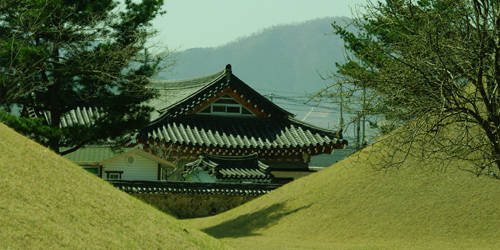
Thumuli Park (Daereungwon) in Gyeongju
The city of Gyeongju , the ancient capital of the Silla kingdom, contains many tombs dating back to this era. It is believed that tomb-building culture emerged on the Korean Peninsula as early as the third century BC. Such tombs have been found in North Korea. The first such tombs appeared in Gyeongju in the late third century.
To create a burial site, a wooden chamber was built. It was a fully functional room, with wooden walls and a ceiling over two meters high. The walls were sometimes decorated with carvings. Not only the body of the deceased was placed in the room, but also their belongings, various objects—of which there could be many, sometimes tens of thousands. There might be more than one room, although most burials were "single-room" burials. The structure was then filled with stones and covered with earth, creating a large mound. Grass grew on the mound, and even trees could grow. There are many such mounds in the Gyeongju area, over two hundred, and they impart a certain essential element to the local landscape: a stern, unshakable, soul-soothing peace.
It might seem like a strange idea to create a park on the site of ancient burial sites. But that's exactly what they did in Gyeongju. As usual, to further confuse tourists, guidebook authors, and travel agency staff, the park has been given more than one name. It's called either Tumuli Park or Daerungwon Park. Be careful: they're the same place! If a tour itinerary lists these parks as two different stops, ask for clarification! :)
The park contains 23 tombs, including the Cheonmachong (Heavenly Horse Tomb), excavated in 1974. Excavations of the 13-meter-high burial mound yielded over ten thousand different artifacts, most of which are now on display at the Gyeongju National Museum (including a gold crown and belt). The entrance to the tomb is now open to visitors, and some of the finds remain here, but most have been replaced with copies. It is said that the image of a horse, found here on a birch board that once adorned a saddle, is the only surviving drawing from the Silla period. It is this find that gives the tomb its name. Scholars have never been able to determine with certainty who is buried in the Cheonmachong tomb. It should be noted that not only kings but also other nobles, such as high-ranking military officers, were buried here. However, it is precisely one of the kings that is buried in Cheonmacheon, as is irrefutably proven by the crown that was found.
But in most cases, it is known who exactly a particular tomb belongs to. Supposedly, the tomb of King Mukhi, who defeated the forces of the Baekje state in fierce battle, is also located in Thumuli Park. An interesting legend is associated with this tomb. Mukhi's successor was suddenly attacked by an enemy army. Defeat was inevitable, but then, brave warriors with bamboo leaves in their ears suddenly appeared, deciding the outcome of the battle in Mukhi's favor. After the battle, the warriors also suddenly disappeared. But the bamboo leaves remained lying near Mukhi's tomb, indicating that it was his spirit that sent the warriors to earth. Since then, the tomb has been called the "bamboo tomb." This burial site is closed to the public and is surrounded by a fence.
Of course, many burial mounds were looted. An example is the Hwangnamdaebun burial mound. This mound was built over ten paired burials. Royal consorts, or kings, were buried here with their sons. The mound is very large: it reaches a height of 23 meters and a diameter of 250 meters. The looted Hwangnamdaebun burial mound dates back to the same sixth century as Cheonmachong.
Since this is not only a park but also a cemetery, albeit an ancient one, you should immediately discard the idea of climbing one of the hills and taking a photo. Some guidebooks even warn against this. Although, I must admit, there are hills with fairly clearly visible paths leading to the top. Still, for some, the desire to climb higher and take a photo outweighs their respect for the ancient graves.
