Venetian Impressions
Rayons of Venice
How do you say it in Venetian?
Bridges of the Grand Canal
Doge's Palace
Temples of Venice
Saint Mark is the patron saint
Torcello Island
Burano and Mazzorbo
Venetian glass
History of Venice
 Venetian Arsenal
Naval History Museum
Coat of arms and flag of Venice
The Greats in Venice
Parks of Venice
High water
Food in Venice
Venice Transportation
Venice Airports
Venice train station
Books about Venice
Mestre
Hotels in Venice
Municipal Internet Ve
News

Venetian Arsenal
For centuries, the Arsenal was the beloved brainchild, a source of glory, and a source of pride for the Venetian Republic. The Arsenal was shown off as a curiosity to distinguished guests of the Most Serene Highness. In some years, the Republic spent more than 10 percent of its budget on the Arsenal. Around 16,000 people worked there—one in ten Venetians—and most of them were highly skilled specialists in their fields: carpenters, ropemakers, and blacksmiths. The Doge called upon the Arsenal's workers, the arsenalotti, for aid in times of danger, they formed his escort on holidays, and from the arsenalotti, the state guard was recruited. After the famous fire of December 20, 1574, which destroyed a significant portion of the Doge's Palace , meetings of the Great Council of the Republic were held in the Arsenal—a Council at that time comprised 1,500 Venetian nobles (aristocrats).
The idea of consolidating the shipbuilding workshops scattered across the lagoon's islands into a single, centralized facility belonged to Doge Falier Ordelafo (1102-1117)—a project exceptionally ambitious for its time. Ordelafo wanted to place shipbuilding under the control of the Republic—nowadays, we would say the Doge decided to nationalize Venice's vital shipbuilding industry. The project was put into motion, and fifty years later, in the eastern part of Venice, on the two islets of today's Castello , a powerful complex of shipyards, foundries, warehouses, and workshops emerged. A new word, "arsenal," was coined in English and many other languages. (From the Arabic "dar as-sinaa," meaning workshop.)
It's difficult to overstate the impact of this reform. The Arsenal was designed to handle a colossal volume for its time—the simultaneous construction of twenty forty-meter galleys. To give a sense of the seething inferno, Dante describes the Arsenal in action in his Divine Comedy. Working tirelessly, the Arsenalotti could launch a fully equipped warship in just a few hours! A guest of Venice, King Henry III of France, was escorted to the Arsenal early one morning and shown the keel of a vessel under construction. That same evening, at sunset, he was brought back: the completed ship had already been launched from the slipway—fully equipped, armed, and provisioned; a fully staffed and pre-trained crew awaited embarkation on shore!
(France had always been a vital interest of Venice, and especially so during the reign of Henry III. Eyewitnesses claim that between his first and second visits to the Arsenal, the king was given a dinner consisting of 2000 (!) courses. And after the sun had set, the twenty-four-year-old king was taken to visit the famous Venetian courtesan (and poetess) Veronica Franco. It's no wonder Henry carried away the warmest feelings for Venice from the shores of the lagoon.)
With the advent of the Arsenal, the speed of shipbuilding became dependent solely on funding. At critical moments, the Republic imposed additional taxes, wealthy patriots among the city's citizens would undertake to build one or more galleys at their own expense, and the fleet's size rapidly grew. It was not uncommon for a crushing defeat, say, at the hands of the Genoese, when dozens of galleys were destroyed or captured, to be restored in just a few months! The Arsenal made extensive use of standardization and interchangeability, allowing for the creation of spare parts warehouses and the rapid completion of even major repairs.
New technologies also influenced ship design: it was during this time that ships began to be assembled on a prefabricated spar (frame), rather than being sewn together plank by plank from the bottom up, as had been the case previously. As early as the 12th century, Venice began producing ships of various designs: some for war, others for trade.
It was the time of the Crusades , which Venice entered as a seaside city, like many others, and emerged as a powerful ruler of the Mediterranean…
The 14th to 16th centuries were the golden age of the Venetian Republic. For the Arsenal, this was also a time of expansion and construction. In 1326, the Arsenale Nuovo (New Arsenal) was built in addition to the Arsenale Vecchio (Old Arsenal) . The combined Arsenal could simultaneously build 80 ships!
What times those were! The stocks were bustling with activity all day long. All Arsenal workers received free wine in addition to their wages—the quota increased depending on their position and reached up to 4,5 liters per day. So, 600,000 liters of wine alone were purchased annually for the Arsenal's needs!
In 1473, the third, Modern Arsenal ( Arsenale Nuovissimo ), was founded to build even larger ships. Its construction dragged on for almost a century, hampered by wars, the resulting financial difficulties, and the strange explosions of gunpowder magazines that rocked the Arsenal in 1509 and 1569. Curiously, the explosion of March 14, 1509, occurred during a meeting of the Great Council, and Venetian nobles, having cast off their robes, participated in the rescue efforts.
These days, it's impossible to enter the Arsenal grounds—it's a "zona militare," meaning no one is allowed in. And this despite the fact that the Arsenal no longer builds ships; it now only carries out minor repairs. But it did so quite recently, right up until World War II.
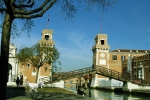
Intrigued tourists now crowd around the Arsenal's twin gates—one for ships, one for pedestrians—trying to peer into the closed-off area from the high bridge spanning the canal leading to the Arsenal. Most are perplexed: so what's so special about it? From the bridge, they can see part of the inner waters, deserted piers, empty warehouses... And once upon a time... Once upon a time, Dante saw a seething, thundering, tar-smelling Underworld beyond these gates.
Sitting with a glass of spritz in one of the nearby cafes, one can only try to imagine what everything looked like here several centuries ago, when the Arsenale laid the foundation for Venice's wealth and glory. And admire the gates' lavish Venetian decorations…
Since 1460, the pedestrian entrance has been adorned with a triumphal arch erected by Antonio Gambello to commemorate the victory over the Turks. The lions seated before the entrance were brought to Venice from Athens by order of the Doge and legendary Venetian military leader Francesco Morosini.
A winged lion and two winged Nikes adorned the portico in 1571 after the famous victory at Lepanto. Incidentally, the battle with the Turks at Lepanto is considered one of the largest naval battles in history. Cervantes, the author of Don Quixote, took part in it, being wounded three times in the battle and losing an arm.
Russians will be surprised to note that the high, crenellated red brick wall surrounding the Arsenal is very similar to the Kremlin in Moscow. This is a pleasant surprise. And it's not surprising: the Kremlin walls were designed by architect Pyotr Fryazin, who was born Italian, Pietro Antonio Solari.
You can get an idea of the Arsenal's size by cruising along its walls on vaporetto lines 41 or 42. These are circular routes around Venice: line 41 goes clockwise, line 42 counterclockwise. Perhaps late in the evening, when you've had enough of walking the streets and embankments, we highly recommend taking one of the vaporetto lines 40 near San Marco Zaccaria. Venice will reveal itself to you from a variety of, often unexpected, sides. The trip takes about an hour and a half, of which about fifteen minutes will be cruising along the austere and slightly gloomy walls of the Arsenal.
There will be time to think about endings and beginnings, causes and effects, ups and downs... And also about other important things.
Pavel Vereshchagin