Venetian Impressions
Car gates Vienna...
How to get off the cockroach trail...
 Grand Canal
Lack of urban chi...
Life on the water
Venice Carnival
Carnival masks of Venice...
Theatrical masks of Venice
La Fenice Theatre
Solitude in Venice
Venice Film Festival...
Morning in Venice
Historical Regatta
Venice Biennale
Rialto Fish Market
Getting lost in Venice
How we rented an apartment in...
Seven days in Venice
Orchestras in the Plaza San M...
Monument to Carlo Goldoni
St. Mark's Square: on the st...
Venetian courtesans
Feel or features in...
Rayons of Venice
How do you say it in Venetian?
Bridges of the Grand Canal
Doge's Palace
Temples of Venice
Saint Mark is the patron saint
Torcello Island
Burano and Mazzorbo
Venetian glass
History of Venice
Venetian Arsenal
Naval History Museum
Coat of arms and flag of Venice
The Greats in Venice
Parks of Venice
High water
Food in Venice
Venice Transportation
Venice Airports
Venice train station
Books about Venice
Mestre
Hotels in Venice
Municipal Internet Ve
News
Grand Canal
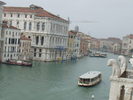
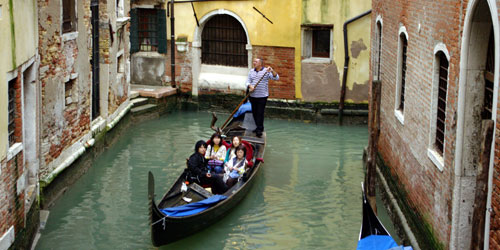
The Grand Canal is the main and largest street in Venice, its primary transportation artery. Its upper section houses the train station and Piazzale Roma, where all motorized traffic arrives and departs.
If you want to travel along the entire canal, then the vaporetto is your number one choice. However, it can be difficult to get on during rush hour. In the morning, the main flow of passengers is from the station to San Marco, and in the evening, it's the other way around. All vaporetti have a few seats at the stern, which locals usually don't use. From there, you can admire and photograph both banks. Some vaporetti also have seats at the bow—these are more popular with tourists and therefore usually full. For "geographical idiots" like me, this route is a real lifesaver. You can get off at each stop (they strictly alternate banks—once on the left, once on the right) and make short loops without the risk of getting lost (husband—don't laugh!). There is no embankment along the Grand Canal.
All the major palaces (there are many!) are, of course, located on the Grand Canal. However, Venetians only call the Doge's Palace a palace (palazzo) . The rest are simply houses (casa). Abbreviated simply as "Ca," and then usually the last name of the original owner.
Even the untrained eye can see that the houses along the canal, despite their varied appearances, share a common layout. Typically, you'll see a large front entrance, suitable for mooring a gondola or other small vessel, and above it a row of large windows, taller than those on the upper floors. In the evening, when everything is illuminated, you can see that behind the front door is a large vestibule with an exit to the opposite side of the building, and above that, a spacious hall, the sides of which once housed offices and storage spaces.
Every house in Venice is built on stilts. The goal of "lightening" the building was one of the architects' primary concerns. Furthermore, the ground floors are often submerged during high tides and floods. This U-shaped design of Venetian buildings, with its mass distribution and through passage, has stood the test of more than a thousand years of Venice's history.
I really wanted to test all my fantasies and really wanted to admire the Grand Canal from a palazzo. Not all of them are open to the public, but in what I consider to be the most elegant and elegant palazzo (I'm not Venetian, so I'll call them palaces), the Ca d'Oro, is home to the Franchetti Gallery, and you can visit it!
The Ca' d'Oro palace is called the Gothic pearl of Venice. It looks as if it were woven from lace. In one guidebook, I came across the apt description: "air-eaten." It's a shame the gold leaf paneling hasn't survived. It's thanks to this paneling that the palace got its name—the Golden House. Actually, the palace was built in the first half of the 15th century by order of the Venetian patrician Mario Contarini and was originally intended to be called Ca' Contarini. But the name didn't stick. In addition to gold leaf, the palace was painted with the most expensive paints of the time—cinnabar and ultramarine. I can imagine how magical it looked in the shimmering Venetian air.
They say the same crew that built the Doge's Palace was hired to build the Golden House. The house's history also has a Russian side. In 1846, Prince Trubetskoy purchased it, though a year later he gifted it to the famous ballerina Marie Taglioni. This poor woman earned the reputation of Herostratus for her renovations, which destroyed much of the building's interior, a fact mentioned in every guidebook and book about Venice. Baron G. Franchetti saved the palace from complete destruction. Furthermore, this kind man not only completely restored the building but also donated it, along with his art collection, to the city.
It must be said that Venice was often gifted collections of paintings, books, and the like, often along with the house where all this treasure was housed. They say this collection is unique, but to me it seemed that, like any private collection, it had a little bit of everything.
The vaporetto stop is right outside the palace and is also called Ca' d'Oro. The entrance is on the side perpendicular to the Grand Canal. It's hard to miss, as there are usually a couple of tourists standing there, trying to catch a glimpse of the palace's beautiful courtyard through the small window in the door. Admission is 10 euros.
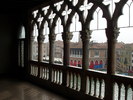
Of course, I went up to Mantegna's "Saint Sebastian" and Titian's "Venus," but soon enough I ran off to fulfill my dream—I went out onto the balcony with its delicate arches to admire the Grand Canal and finally spotted the numerous little lions on the palace balconies. You could stand there for hours. I stood there, then went up a floor and went back to stand on the balcony... When I went down to the first floor, I discovered the door to the courtyard was closed. I approached an employee, and he explained that the first floor was flooded and that I could stroll around for an hour or two and use the same ticket to enter again.
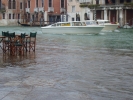
And indeed, when I approached the palace on the vaporetto, the steps of the main entrance (in Venice, the entrance from the canal is considered the main entrance, while the street entrance is the back entrance) were underwater. I didn't think anything of it at the time; I guess I hadn't yet gotten used to the city's tidal cycle.
I returned a couple of hours later, and the water had already receded. However, I was warned several times that it was very, very slippery.
The vestibule is the palace's most beautiful room. A mosaic floor with small puddles of Adriatic water, Gothic windows overlooking the canal, and a few solitary statues. To the left is a courtyard with a beautiful pink marble well. I approached the window. Green seaweed remained on the marble steps after high tide.