Venetian Impressions
Car gates Vienna...
How to get off the cockroach trail...
Grand Canal
 Lack of urban chi...
Life on the water
Venice Carnival
Carnival masks of Venice...
Theatrical masks of Venice
La Fenice Theatre
Solitude in Venice
Venice Film Festival...
Morning in Venice
Historical Regatta
Venice Biennale
Rialto Fish Market
Getting lost in Venice
How we rented an apartment in...
Seven days in Venice
Orchestras in the Plaza San M...
Monument to Carlo Goldoni
St. Mark's Square: on the st...
Venetian courtesans
Feel or features in...
Rayons of Venice
How do you say it in Venetian?
Bridges of the Grand Canal
Doge's Palace
Temples of Venice
Saint Mark is the patron saint
Torcello Island
Burano and Mazzorbo
Venetian glass
History of Venice
Venetian Arsenal
Naval History Museum
Coat of arms and flag of Venice
The Greats in Venice
Parks of Venice
High water
Food in Venice
Venice Transportation
Venice Airports
Venice train station
Books about Venice
Mestre
Hotels in Venice
Municipal Internet Ve
News
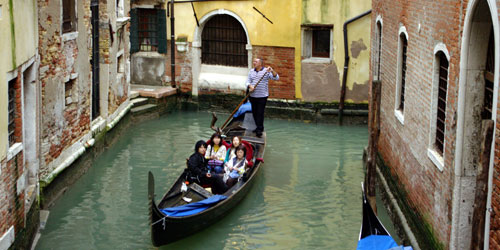
Lack of urban sculpture. Campo Santi Giovanni e Paolo.
Venice is everything, the individual is nothing. Under this slogan, the Venetian Republic existed for nearly fifteen hundred years. The entire system of governance and the election of the Doge (head of the republic) were aimed at eliminating any possibility of a personality cult developing around any single individual. Perhaps this is why Venice, unlike other European cities, has virtually no monuments.
I counted four: a monument to Garibaldi, a monument to Daniele Manin, who organized and led the Venetian resistance against the Austrians, and a monument to the first king of a unified Italy, Victor Emmanuel II, on the very busy embankment leading from the Doge's Palace to the Arsenal. And finally, a monument to the condottiere Colleone, which is practically unnoticed by anyone—apparently the only monument from the time of the Venetian Republic, and not even to a Venetian or a Doge!
The story of the origin of this monument, like the story of Venice's excommunication from the Catholic Church, is cited in all guidebooks and books about Venice, so vividly does it illustrate the cunning, treachery, and resourcefulness of the republic's rulers.
Condottieri are mercenary military leaders. Bartolomeo Colleone of Bergamo was as bold and successful as he was unscrupulous. He defected to Milan several times, but his most glorious victories came in defense of the Venetian Republic. Colleone amassed a vast fortune (I suspect not through commercial dealings). I don't know if he had a family, but in his later years, thoughts of immortality apparently became so obsessive that he promised to bequeath his entire fortune to Venice if the Venetians would sign a treaty with him to erect a monument to him at the Basilica of San Marco. Yet even the doges couldn't be granted such an honor! The money-hungry rulers of Venice signed the treaty, but cunningly replaced the words "at the basilica" with "at the walls of San Marco."
The old soldier didn't read the treaty carefully... As a result, 20 years after Colleone's death, the monument was erected... at the walls of the Scuola San Marco on Campo Santi Giovanni e Paolo (San Zanipaollo in Venetian), because keeping the treaty is a sacred thing for a republic that lives by trade.
But the fearless condottiere shouldn't be too upset. The square is truly beautiful and a must-see even on a one-day trip. We recommend approaching it from the canal along Calle Largo Galina. The somber Gothic façade of the Church of Santi Giovanni e Paolo will appear suddenly, as if rising from the ground. Considered the largest Gothic church in Venice, the church was founded in the 13th century by the Dominicans and took nearly 200 years to build. After its consecration in the 15th century, it now serves as the doges' tomb.
In addition to the 25 doges buried in the temple , the famous Venetian artist Bellini is also buried here , and his name was immortalized in the name of the cocktail he invented by the owner of the famous Harry's Bar . I strongly recommend avoiding buying a bottle of the vulgar pink liquid with the "Bellini" logo in the shops. Spend 10 euros on an authentic wine and peach juice cocktail at Harry's Bar, consoling yourself with the thought that you're drinking in the favorite bar of Hemingway, Brodsky, and Rothschild.
But let's return to San Zanipaolo... The church is worth visiting not only for the diversely decorated Renaissance tombs of the Doges. Those interested in painting will see works by Bellini, Lotto, Conegliano, and Veronese. However, Bellini's famous "Madonna" and Titian's "The Martyrdom of St. Peter," which hang at the entrance to the church, are copies; the originals were destroyed in a fire in 1867. Furthermore, the church contains a 15th-century Gothic stained-glass window, made of Murano glass , of course , and stained glass is rare in Venice; due to the unstable soil, they were not allowed to be made.
To the left, perpendicular to the church and somewhat dissonant, stands the white, ornate Renaissance building of the Scuola Grande di San Marco, richly decorated in marble, naturally flanked by two lions at the entrance. It now houses a hospital.
And finally, the square's third highlight is the monument to the condottiere Colleone. The monument is inscribed with the name "Alessandro Leopardi." How unfair history is! The monument is considered one of the finest bronze masterpieces of the early Renaissance and even the greatest equestrian monument in the world. Leopardi had just completed the work of the famous Florentine sculptor Verrocchio, who had been specially commissioned to create the monument. Verrocchio began with the horse. The sculpture turned out magnificent, but for some reason, the Venetian rulers decided to invite another sculptor to create the figure of Colleone himself. The enraged Florentine master knocked the horse's head off and returned to his homeland. The offended Venetians responded by forbidding the sculptor from setting foot on Venetian soil under threat of execution—specifically, beheading. To which Verrocchio responded in kind: "You're fools, chopping it off isn't hard, you won't put it back on. But I broke the horse's head myself, so I can put it back on myself." The response pleased him, a truce was concluded, and Verrocchio returned to work. For double pay.
Death prevented him from finishing the monument. It's truly remarkable. The horse is graceful, and the condottiere looks very martial.