Venetian Impressions
Rayons of Venice
 How do you say it in Venetian?
Bridges of the Grand Canal
Doge's Palace
Temples of Venice
Saint Mark is the patron saint
Torcello Island
Burano and Mazzorbo
Venetian glass
History of Venice
Venetian Arsenal
Naval History Museum
Coat of arms and flag of Venice
The Greats in Venice
Parks of Venice
High water
Food in Venice
Venice Transportation
Venice Airports
Venice train station
Books about Venice
Mestre
Hotels in Venice
Municipal Internet Ve
News
How do you say it in Venetian?
Venetians consider "Venetian" to be their nationality and their language, Venetian. Those in the know say the Venetian dialect is significantly different from Italian. Furthermore, there are a number of words used with their meanings only in Venice. This primarily concerns toponymy, so I'll list a few words and their meanings here, as knowing them will make it much easier for you to navigate the area called Venice.
Venice is divided into six districts , or sestiere : San Marco, Castello, Canaregio, San Polo, Santa Croce (you're unlikely to visit it, it's where the docks are), and Dorsoduro. For Venetians, the district they were born in and where they live is important; each district has its own community center and local archive. A Venetian's address is given without the traditional street name, only the district name and house number. Houses are numbered consecutively within each sestiere. Sometimes, the address includes a nearby street, bridge, canal, church, or other famous landmark.
From what you're used to reading on signs in other Italian cities, Venice has:
- one road (road) - Strada Nova, and it was built in the nineteenth century, it was laid in the Cannaregio district to somewhat untangle the labyrinth of streets.
- two via (streets) – Via 22 Marzo in San Marco and Via Garibaldi in Castello.
- one square (piazza, square) - namely the main square of Venice, Piazza San Marco, with two piazzettas adjacent to it (piazzetta – small square) - one Piazzetta di San Marco is a small square between the piazza and the lagoon and is usually called simply Piazzetta, the second piazzetta de' Lioni is a piazzetta to the left of the Cathedral of San Marco with lions. There are no other piazzettas in Venice
- there is one palace - Ducal Palace Doge's Palace, the rest, in our non-Venetian view, are also palaces, called houses (Home Insurance), which were eventually shortened to Ca (Ка), for example Ca-d-Oro – Golden Palace.
Venetian signs with the names of streets, squares, and the like are white with black letters; they're called nissioeti. They're quite ancient, so sometimes, when they're renovated, ignorant workers rewrite the names in the new Italian style. This is why the same street can sometimes have slightly different names along its length. And if a name contains a single "o" between words, it means it's Lenin or Gorky Street—the choice is yours. Yellow arrow-shaped signs on the walls of buildings are direction signs. For example, "All WC" means there are restrooms, and "All San Marco" means the direction is Piazza San Marco.
Streets in Venice are most often named street (calle). also often found wrinkle (swearing, alley), and sometimes rugetta (rughetta) – also streets, no worse than kale. The narrower street is called bouquet (frame). If you see the word on the sign salizzadA (salitsada) is also a street, only paved. This word has remained since prehistoric times, since everything is paved these days—kale, ramo, and ruga. Streets can also be:
- Rio Terra - this means that this street arose on the site of a canal
- list – a very wide street. It used to run in front of embassy palaces and was considered part of the respective country, with all the inviolability that entailed. It was paved with white stones.
A common occurrence is – sottoportego A sottoportego is a covered passageway (gateway) in or between buildings. It's scary to enter at first, especially at night, but then you get used to it; it's safe to walk around Venice at any time of day.
The embankments along the canals in Venice are called foundations (fondamento), if there is a large body of water nearby (the Grand Canal, for example, or lagoons), the embankment can (but does not have to!) be called shore (riva). A riva is a natural embankment, a fondamenta – a stone foundation for houses and streets along a canal.
Russians, accustomed to vast open spaces, are particularly surprised by squares—any expansion, however insignificant, in our opinion. So we sometimes lost our way, passing the square we were looking for, perceiving it as a small courtyard.
The squares in Venice are called field (campo), translated as a field, apparently grass used to grow there, there are very small areas, smaller than our courtyards - they are called small square (campiello) - a type of clearing. There is also court (court, courtyard)! It can be a dead end, it can be a passageway, but it has no more than two entrances (which are also exits), and there is no church, no market, no cafe. Oh wow!
Now about the city's waterways. Only two are called canals: Grand Canal and Giudecca. At least, that's what's written in a book by the Venetian writer Tiziano Scarpa. A map bought in Venice also shows the Canareggio Canal. The other canals are called rio.
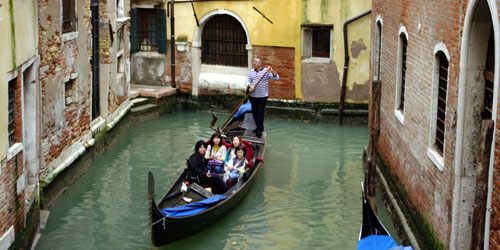
Bridges are called ponte. On the Rio, you can often see pontezellos—small private bridges leading directly to the entrance of a house. Only four bridges span the Grand Canal.
In several places you can cross the canal трагетто – a public gondola, rowed by two rowers, very popular with locals. It can accommodate up to 20 people, who float standing up, facing the approaching shore, much like penguins floating on an iceberg. The crossing costs 50 euro cents. Stops can be identified by large green signs reading "TRAGHETTO." One stop is at Ca' d'Oro, near the vaporetto stop of the same name, and takes you to the Rialto Market. Very convenient. Main public transport vaporetto (vaporetto) – water trams. The most popular route among tourists is #1 – it travels along the Grand Canal, making frequent stops on both banks.
Along the Grand Canal and in the lagoon, you'll see numerous pointed logs tied together. These are called bricoles —they mark the shallows and the channel, and are marked with white paint on the navigable side. In the lagoon, lanterns are hung from them along the channel. Good landmarks in the city and on the islands are the campaniles —square bell towers with virtually no windows, usually standing next to, but separate from, churches. Many are leaning, seeming ready to fall at any moment. On Burano, it 's downright scary to stand next to them; you feel like they're about to collapse. The most famous campaniles with viewpoints among tourists are the Campanile di San Marco and the Campanile di San Giorgio Maggiore.