Venetian Impressions
Rayons of Venice
How do you say it in Venetian?
Bridges of the Grand Canal
Doge's Palace
Temples of Venice
Saint Mark is the patron saint
 Torcello Island
Burano and Mazzorbo
Venetian glass
History of Venice
Venetian Arsenal
Naval History Museum
Coat of arms and flag of Venice
The Greats in Venice
Parks of Venice
High water
Food in Venice
Venice Transportation
Venice Airports
Venice train station
Books about Venice
Mestre
Hotels in Venice
Municipal Internet Ve
News
Torcello Island
If you've tired of Venice's numerous canals, opulent palaces, and opulent churches, it's time to visit the island of Torcello . The route to it lies via Burano . Take the vaporetto , route "T," and in half an hour you'll be on Torcello.
Even along the way, passing small grassy islets and lowlands swamped by ash-gray seawater, the carnival-restaurant mood begins to shift to a melancholic, contemplative one. The colors fade, and the presence of aquatic life becomes palpable among the tall, withered reeds. The color of the water and the lighting become more subdued. Upon landing on Torcello, you immediately sense the island's desolation and sparse population. Some sources say 80-100 people live here, while others say only 30.
The island was once home to 20000 people—descendants of the inhabitants of the mainland city of Altinum. According to one legend, as barbarians approached, the city's inhabitants received a sign from heaven. They heard a voice advising them to climb the city tower (called Torcello) for salvation. The people obediently ran up the tower and saw an island in the lagoon. They swam there, fleeing the barbarians. This occurred in the 5th century. Soon, in 639, the bishop of Altinum also moved his residence there.
Once you get off the vaporetto, you'll find only one road running alongside the canal. It will take you to the ancient church, basilica, and campanile—the island's main landmarks. The canal is not wide, with no buildings on the right bank and a few cozy roadside restaurants on the left. It's said that Torcello's land is difficult to adapt to agricultural use because the foundations of houses from the former large city remain in the ground. Only in the distance, near the shore of the lagoon, can you see a building resembling a farm.
The island's inhabitants fled, fleeing malaria. Something happened, and the tides stopped renewing the water around the island, causing this part of the lagoon to become swampy and turn into a so-called "dead lagoon" teeming with malaria-carrying mosquitoes. In the 20th century, the swamps were drained, the foundations of the remaining buildings were strengthened, the basilica's mosaics were cleared and restored, and Torcello became one of the lagoon's most visited islands. A significant share of tourism revenue was added to the traditional fishing industry.
About halfway along the path is Devil's Bridge, next to a bar of the same name. The bridge is stone, without railings. After crossing it, you'll see an enticing path, but don't follow it; you'll end up on some private property, and at the beginning, you'll be greeted by a large sign: "No restrooms here!"
In the gardens around the few restaurants and hotels I saw pomegranates cracked from overripeness on the trees for the first time; among the small yellow foliage, these blood-red, wet flowers looked rather ominous. Not far from the basilica, on the right, there are small green houses (resembling doghouses) with the word "Dingo" written on them; cats live in them. Apparently, they are descendants of Venetian cats. Just a few decades ago, according to a book by the famous travel writer G. Morton (circa the early 60s), cats were numerous in Venice. They were considered relatives of the lion. St. MarkThen dogs and cats became fashionable, and I assumed they were exiled to Torcello. There's a donation bowl next to the houses.
The canal ends at a small square (I somehow didn't notice where the canal had disappeared to), home to all the island's main attractions. The stone throne in the middle of the lawn and the octagonal church in the early Byzantine style immediately catch your eye. That's why the two small buildings on the left look like outbuildings. In fact, they're Torcellian palazzi from the early 14th century, just very small by Venetian standards.
The stone throne is called Attila's Throne, although, fortunately for the locals, Attila never came here. It is said that judges sat on the throne. Naturally, it is now a popular destination for tourists, especially young women – according to legend, whoever sits on it will surely get married within a year.
The octagonal Church of Santa Fosca, with its Greek marble columns, and the Cathedral of Santa Maria Assunta are considered the oldest churches in the Venetian Lagoon (638), and are also among the only examples of early Byzantine architecture that have not been rebuilt. Next to them stands a tall campanile, offering a stunning view of the lagoon. Unfortunately, due to its age, it is often closed for renovations.
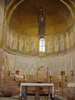
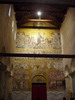
The isolation of this complex from the "large world," the lack of decoration on the façades, and a certain gentle austerity create a mood similar to that evoked by visiting the early Christian catacombs on the Appian Way in Rome, when the faith was young, persecuted, and untouched by intra-denominational strife. Inside, the cathedral is laid out like a typical basilica: a large central nave and two side naves. The marble columns supporting the vault of the central nave are decorated with fine carvings. The central nave is significantly higher than the side naves and is lit by large arched windows. Similar windows are found in the side naves. The church is bright, and the famous mosaics are clearly visible. The apse contains a stunning mosaic of a weeping Madonna and Child against a golden background. It's executed in the Byzantine style familiar to us Russians—a long silhouette in blue and gold robes, a slender face with enormous Byzantine eyes, and a frieze with the twelve apostles below. On the opposite wall is the Last Judgment. As always, the depiction of this event is very crowded, and, as always, the people in it look lively and diverse. The cathedral's bishop's pulpit is also simple and unadorned.
Despite the basilica's small size and the lack of Renaissance splendor and excessive detail, the cathedral is a place you can linger for a long time. The mosaics on the walls, dome, and floor are unobtrusive, creating an atmosphere of empathy. to the first residents Torcello. Persecuted by the barbarians, having lost everything, they built this temple not for glory, but for salvation. Here they brought their prayers, aspirations, and hopes that their new homeland would not be burned and plundered like their native Altinum. I found George Ruskin's observation in "The Stones of Venice" very accurate: that the cathedral on Torcello, unlike most Venetian churches, is completely devoid of vanity.