|
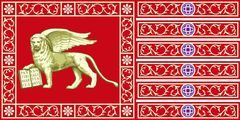
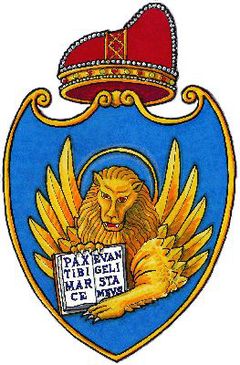
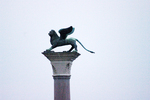
The main symbol of Venice is the golden winged lion of St. Mark the Evangelist ; this symbol is present on both the coat of arms and the flag of Venice.
The symbol originates in the prophecy of Ezekiel and is described in the Old Testament: “And I looked, and, behold, a stormy wind came from the north, a great cloud, and fire enfolding itself, and a brightness was all around it, and from the midst of it there appeared as the light of a flame out of the midst of fire. And from the midst of it appeared the likeness of four living creatures. And this was their appearance: their appearance was like that of a man;… The likeness of their faces was the face of a man, and the four of them had the face of a lion on the right side; and the four of them had the face of an ox on the left side, and the four of them had the face of an eagle” (Ezek. 1:4, - 1:5; 1:10). It is believed that the four creatures seen refer to the four evangelists: Matthew, Mark, Luke, and John.
These attributes were substantiated by Saint Jerome in his commentary on Ezekiel at the beginning of the fourth century. To describe Saint Mark, Jerome chose the beginning of his Gospel: "The voice of one crying in the wilderness: 'Prepare ye the way of the Lord, make his paths straight'" (Mark 1:3). Jerome associated this "voice crying in the wilderness" with the roar of a lion. According to the saint's commentary, Mark was given a lion because it was he who proclaimed the kingship of Christ. Saint Mark's lion symbolizes the efficacy, dominion, and kingship of Christ, and his Resurrection from the dead.
Since 828, the holy relics of the Apostle Mark have been kept in Venice: they were secretly removed from Alexandria by Venetian merchants on the orders of Doge Giustiniano Partecipiazo when it was occupied by Muslims. At that time, Saint Theodore was considered the patron saint of Venice, but his place was soon taken by the Evangelist Mark, who became the city's first patron saint.
After some time, the Venetian Republic adopted the official name Serenissima Repubblica di San Marco, and placed the golden winged Lion of St. Mark on its coat of arms and on the coats of arms of all cities and lands subject to Venice.
The coat of arms of modern Venice depicts a lion on an azure background, holding a silver open book in its paws. On the left page of the book are the words "PAX, TIBI, MAR, CE," and on the right, "EVAN, GELI, STA, MEUS." Translated, this means "Peace be with you, Mark, my evangelist." The crown of the coat of arms features the ruler's red cap. An image of a golden winged lion holding a book in its right forepaw is also featured on the flag, on the left side. The lion is also the symbol of the merchant and naval fleets of the Venetian Republic.
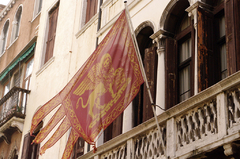
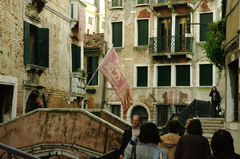
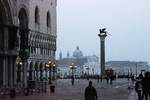
During wars, the book in the lion's paws on the coat of arms or military flag was replaced by a sword. The image of a winged lion with a book in one paw and the other raised, as if in salute, can often be seen in many places and even the most secluded corners of Venice.
Sofia Durynina
|


 Coat of arms and flag of Venice