Venetian Impressions
Rayons of Venice
How do you say it in Venetian?
Bridges of the Grand Canal
Doge's Palace
Temples of Venice
Saint Mark is the patron saint
Torcello Island
Burano and Mazzorbo
Venetian glass
History of Venice
Venetian Arsenal
Naval History Museum
Coat of arms and flag of Venice
The Greats in Venice
Parks of Venice
High water
Food in Venice
Venice Transportation
Something about gondoliers
 Vaporetto
Traghetto
Venice without cars
Metro and minimetro in Venets...
Venice Airports
Venice train station
Books about Venice
Mestre
Hotels in Venice
Municipal Internet Ve
News
Vaporetto
What is a vaporetto?
Vaporetto – Venice's primary public transportation. These relatively small passenger vessels provide transportation not only within Venice itself but also throughout the lagoon. In terms of their importance to the city, Venice's vaporetto is comparable to the subway in major cities around the world; it's a kind of "water" Venetian metro.
The design of the ships is determined by several requirements. They must pass under the relatively low Venetian bridges, first of all bridges of the Grand CanalTherefore, for example, they cannot have a high pilothouse. Ships must not create large waves. This is crucial for Venice, as regular high waves damage embankments and buildings. They must be maneuverable, dock and unmoor quickly, and be suitable for transporting disabled people.
Vaporetto history
Most tourists believe that the vaporetto is a product of technological progress in recent decades. But this is far from the case. The first vaporetto appeared in Venice back in 1881, on a steamboat called the Regina Margherita. The word "vaporetto" itself translates from Italian simply as "steamboat," although, of course, all vessels are now equipped with diesel engines. The experiment with this first vessel was a success; a company was soon formed and eight more steamboats were built. The business was started by French entrepreneurs, and the vessels were also built in France, at a shipyard in Rouen.
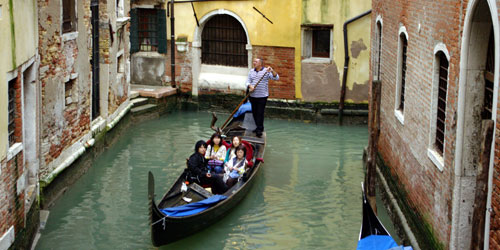
Of course, Venetian gondoliers They immediately realized that the introduction of vaporettos threatened to reduce passenger traffic and, consequently, profits, so the arrival of the new steamboats was met with hostility. The gondoliers' struggle against vaporettos, which periodically erupts in demonstrations and strikes, continues to this day. The main arguments are that the boats pollute the air and water, creating waves dangerous for the gondolas. However, no one now doubts that the city cannot function without motorized water transportation; the only issue is various restrictions. For example, a maximum speed limit on canals was adopted: 8 km/h.
In 1901, following a referendum, control of Venice's public transport was transferred to the municipality. The Municipal Inland Navigation Company was formed, with 23 vessels operating at the time. The company currently employs approximately 3,000 people and is more generally known as the Municipal Transport Company of Venice (ACTV) (Azienda Consorzio Trasporti Veneziano), as it operates not only water transport but also bus services. It operates approximately 120 vessels and 600 buses, operating between Marco Polo Airport, Mestre и Roma Square in Venice. There are several types of boats, varying in size and passenger capacity. The most common vaporettos can accommodate approximately 200 passengers. Boats operate according to a schedule, which can be found on the website. ACTVFor the convenience of residents and tourists, there is a night route marked N.
Vaporetto fares
You often hear that the vaporetto is the most expensive public transport in the world. This isn't entirely true. Of course, if you're not a resident of Venice and are visiting for a short time, each trip will cost €6,5. But you need to visit Venice for at least a week. A weekly pass costs €50. And for that price, you can ride the vaporetto as many times as you want, not only in Venice but also on the lagoon: Murano, Burano, TorcelloThis option doesn't seem so expensive anymore. Tickets are significantly cheaper for Venetian residents, but you'll need to show proof of Venetian citizenship when purchasing them.