Venetian Impressions
Rayons of Venice
How do you say it in Venetian?
Bridges of the Grand Canal
Doge's Palace
Temples of Venice
Saint Mark is the patron saint
Torcello Island
Burano and Mazzorbo
Venetian glass
History of Venice
Venetian Arsenal
Naval History Museum
Coat of arms and flag of Venice
The Greats in Venice
 Parks of Venice
High water
Food in Venice
Venice Transportation
Venice Airports
Venice train station
Books about Venice
Mestre
Hotels in Venice
Municipal Internet Ve
News
Parks of Venice
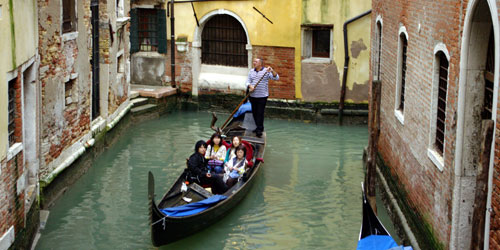
"The Stones of Venice" is the title of a very famous book about Venice by the English historian and art theorist John Ruskin, published in 1851-1852. Water and stone are the two main characters in Venice. The color of the water in the shallow Venetian lagoon differs from the rest of the Adriatic Sea – not at all the cheerful "South Sea" color, but more delicate and slightly frosty, like "our" northern hues. The clarity of the water in the streets during floods is striking. There is no mud. Stone pavements, stone embankments, stone bridges, regularly washed with acqua alta.
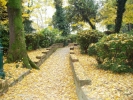
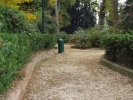
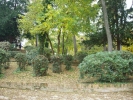
So, discovering a real, albeit microscopic, park right next to the hotel on the fifth day was a real surprise. We'd passed the park entrance every day, unaware of its existence. Savorgnan Park (Parco Savorgnan) can be reached either from the embankment (fondamenta Savorgnan) on the Cannaregio Canal or from Campo San Geremia with its church of the same name. The church is clearly visible from the vaporetto where the Cannaregio Canal flows into the Grand Canal . Vaporetto N51 enters the Cannaregio Canal from the Grand Canal. At the campo, stand with your back to the church and, putting aside your Russian notions of parks, find the narrow entrance. You don't enter this park; you literally dive out of a concrete jungle. The birdsong of this tiny green island is deafening. The vegetation is dense and lush. The park winds through secluded corners around the remains of a fountain and a ruined pavilion. It's so intricate that the appearance of a health group with an instructor and trekking poles was a complete surprise to me. The group emerged from somewhere behind the bushes and headed for the exit. The park, less than a hectare in size, by my imperial standards, is simply a small park in the courtyard of some Stalin-era building on Moskovsky Prospekt. However, as I wandered along the park's winding paths, I managed to avoid the houses where the cats live—those "little lions" revered by the Venetians.
The true champion in terms of the number of winding paths and the number of secluded corners is the Giardini Papadopoli park, which is on the other side of the canal, next to Piazzale RomaIt's even smaller than Parco Savorgnan, but it doesn't have a single meter of straight path. Some ingenious designer of this park twisted them around small hills, and hedges, bushes, and trees, planted in layers, further localize the space. This park has room for relaxing pensioners, kissing couples, and families on a picnic. And no one gets in each other's way, no conflict of interests, since they can't see each other. The park was laid out in 1834 on the site of the Church of Santa Croce and for a long time was a place for promenades and parties for eminent Venetians. It is named after the garden's first owner. With the transition to public ownership, it lost half its area due to the construction of Piazzale Roma and the Ponte della Liberto.
If you're visiting Venice with children, these two parks are the best places to relax and grab a bite to eat. Both parks also have convenient playgrounds. Their location, at the intersection of tourist routes, is also convenient.
Venice once boasted numerous parks and gardens. In the 5th century, there were over 500. Venice was the first city in Europe to establish public parks open to the public. This was likely facilitated by the communal lifestyle of the Venetians. However, as early as the mid-18th century, Casanova wrote that "a park in Venice is a great rarity." Today, only five remain, if we consider the Royal Square (Giardinetti Reali) on the opposite side of Piazza San Marco from the Procuratie to be a park. Their total area is 12 hectares. The Summer Garden in St. Petersburg occupies the same area.
The largest park is located in the eastern part Area Castello. This is a working-class district of Venice, with few ancient buildings, but during Napoleon's time, undeveloped squares remained here. In 1807, the Napoleonic Garden (now the City Garden) was built there, and a little later, the Biennale Gardens, which continue it, host contemporary art exhibitions in odd years and architecture in even years.
On the opposite side of the island, in Cannaregio, there is another small city park, Groggia, quiet and cozy, resembling a small forest. If you go from there, vaporetto Along the island toward Castello, you can see the treetops of several private gardens, one of which belongs to the monastery of Sant'Alvise, another to a five-star hotel located in a former palace, and a third to the Palazzo Cantarini degli Spiriti. In fact, on that side of the island, there are some secret entertainment and gambling establishments, visible only from the water. We couldn't figure out how to get there. We tried to walk along the shore and encountered fences. The most puzzling thing was the silence and darkness outside the windows. Having made an evening foray into the supposed hotspot, we encountered solid fences and barriers, and, most importantly, heard no music or other noises typical of such places. Perhaps this place only hosts such wild revelry in the summer?
A good break from the stone city would also be a trip to the islands Torcello и Mazzorbo. Unlike Murano and Burano, they're nothing like Venice. Mazzorbo looks like a holiday village, and Torcello has endless fields.