Venetian Impressions
Rayons of Venice
How do you say it in Venetian?
Bridges of the Grand Canal
Doge's Palace
Temples of Venice
Saint Mark is the patron saint
Torcello Island
Burano and Mazzorbo
Venetian glass
History of Venice
Venetian Arsenal
 Naval History Museum
Coat of arms and flag of Venice
The Greats in Venice
Parks of Venice
High water
Food in Venice
Venice Transportation
Venice Airports
Venice train station
Books about Venice
Mestre
Hotels in Venice
Municipal Internet Ve
News

Museum of Naval History
Entrance to Venice's Naval History Museum costs a ridiculously small 1,55 euros. By comparison, the Doge's Palace costs 18 euros, and the rather modest halls of the Academy of Fine Arts cost 12 euros. Considering that restrooms in Venice typically charge a fee (even at Santa Lucia train station ) and that you'll be charged 1.50 to 2 euros just to powder your nose, a visit to the Naval Museum can sometimes even be a profitable endeavor.
Meanwhile, this museum has five full floors and more than 25,000 wonderful exhibits.
The first floor is dedicated to ancient weapons, both bladed and firearms—all manner of swords, daggers, sabres, and sabers, as well as arquebuses, arquebuses, multi-barreled muskets, and hand mortars—the ingenious and naive weapons of medieval warfare. Also on display are meticulously crafted models of medieval fortresses built by Venice in Cyprus, Crete, Corfu, and even in Sudak, Crimea—fortresses that once became the scene of historic battles and battles. Until recently, cadets at the Francesco Morosini Venetian Naval School used these models to study the history and tactics of siege warfare.
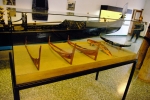
The large exhibition on the second floor is dedicated to the rowing fleet, and this is not surprising: it was with galleys and galleasses that the most glorious period of Venetian maritime history is associated.
Galley warfare tactics were simple: outflank the enemy, outflank, and ram the enemy's side with the galley's specially adapted bow. Beautifully crafted wooden models allow you to see every detail: each rowlock held three enormous oars, each manned by three rowers. The rowers occupied the entire deck, numbering up to two hundred. They rowed standing, facing forward, pressing the oars with their chests, not sitting on benches, as historical films claim. The boarding party huddled in the superstructure at the stern, emerging only during an attack… Incidentally, in recent centuries, rowers were freemen, not slaves.
(How simple and straightforward wars once were. This isn't like spraying nerve gas or detonating a nuclear bomb, calculated to inflict a long, painful death on the enemy from penetrating radiation.)
Incidentally, the last battle of rowing galleys, the legendary Battle of Lepanto, took place back in 1571. Lepanto is one of the greatest naval battles in military history: a coalition of European fleets, led by the Venetian fleet, routed the massive Turkish fleet and finally halted the pressure of the Muslim East on Christian Europe. Let me repeat: this happened in 1571. And in 1588, just 17 years later, the no less famous battle between the Spanish Armada and the Anglo-Dutch fleet took place in the English Channel. And this was a battle from an entirely different era – an era of mastery of sail, skillful maneuvering, tacking in headwinds, long-range artillery…
Miguel de Cervantes and his brother Rodrigo took part in the Battle of Lepanto. The author of Don Quixote was wounded three times in this battle and remained proud of the hand crippled at Lepanto for the rest of his life. A portrait of the Venetian admiral Andrea Doria, the victor at Lepanto, hangs prominently in the historical hall.
The museum has many portraits. The portraits of famous Venetian admirals—Vittorio Pisani, the victor over the Genoese; Pietro Mocenigo, the hero of Antalya and Smyrna; and Francesco Morosini, the scourge of the Turks—are particularly striking. They're unusual: you might think we're looking at a teacher or scholar, not at a warrior who sank dozens of enemy ships and their crews. The paintings capture certain human traits—worldly wisdom, insight, modesty combined with dignity, even grief... One can't help but think of the portraits of legendary Soviet marshals—stern, unyielding, and very strong-willed. However, this is most likely due to the tradition of military portraiture: military leaders around the world belong to the same tribe and resemble one another, but artists consider it important to capture their differences. After all, Soviet marshals are soldiers of the empire, and Venetian admirals are soldiers of the republic.
Incidentally, it was Admiral Morosini's gunners who fired the fatal cannon shot that caused the explosion of an Ottoman gunpowder depot and destroyed one of the Seven Wonders of the World—the Parthenon in Athens. The admiral took the surviving fragments to Venice.
In the halls of the sailing fleet, among the lovingly crafted models of schooners and brigs, frigates and clippers, I could have spent the whole day—if, of course, I'd had more time in Venice at my disposal. I'd wander from model to model, imagining myself now as a sailor furling the sails on the upper yard, now as a cabin boy surveying the horizon from a wicker cradle at the head of the mainmast. Boom-topsail-topmast! Take your places, weigh anchor! Keel and masthead, gunwale and running rigging. Words familiar from childhood, from the books of Stevenson and Jules Verne, still ring in my ears like magical music... The whole day, no less, and if possible, I'd stay the night too—in such a hall, you're sure to have wonderful dreams!
A curious detail: merchant ships were the first to use sails, and only later, many decades later, did military ships follow suit. Historically, the opposite has often happened: military needs spurred the introduction of new technical solutions, and only later did these solutions find their way into civilian life. The fact is that galleys initially remained faster than sailing ships and were not dependent on wind direction in their maneuvers. Sailing ships, in turn, did not require a large, expensive, and fuel-hungry crew of rowers.
In short, my advice: be sure to visit the Naval History Museum. I don't know about women, but men will truly enjoy it. Here, grown men, respectable men, quickly become younger and look a lot like teenagers. And teenagers! Who, tell me, wasn't drawn to the courage of the sea and the romance of distant voyages in their youth?
The largest number of visitors gather in the upper-floor halls dedicated to the 20th century and ships from the First and Second World Wars. Young people admire cross-sections of the equipment and armaments, the colossal innards of modern power machines. They are fascinated by the power and force, the perfection of technology, and the wonders of progress.
There are many other interesting things in the museum.
How about a real steam-powered torpedo, for example? I don't know how you feel, but I was tempted to immediately throw off my jacket, straddle the torpedo, and, hands on the controls, become a brave helmsman, ready to jump into the turbulent sea at the last moment before the explosion.
And what about the collection of naval clothing, from 17th-century blue capes to the diving suits of modern deep-sea divers? And the wax figures of naval officers in dress uniforms from various eras, complete with epaulettes and aiguillettes? And the displays displaying a variety of naval caps, hats, and kepis, collected from all over the world, where, among other exotic items, a sailor cap with the proud and touching inscription "Black Sea Fleet" stands proudly?
And what about the five-foot-tall model of the last Bukintaur, the luxurious golden barge, the buzino d'oro, which ferried the Doge across the lagoon for over half a century? The Bukintaur would have continued to serve if not for Napoleon and his soldiers: in 1798, the barge was dismantled for its precious furnishings. Some of the recycled metal was used to build the famous Column of the Revolution on Place Vendôme in Paris.
The attic hall houses a collection of gondolas—of course they are—and not just models, but actual boats that sailed the canals and were later added to the museum. Of particular interest is the elegant and precious gondola once occupied by the eccentric Peggy Guggenheim, as well as a specimen donated to the museum by the British Consul. In Venice, even diplomats travel by water, without the need for limousines with distinctively colored license plates and flags on the hood.
Incidentally, the museum was founded by the Austrians when Venice was part of the Austrian Empire. This is the second good deed the conquerors performed on Venetian soil. The first, as is well known, was the invention by the occupiers of a refreshing drink called the Aperol Spritz . It's not served in the museum, of course, but elsewhere in Venice, it remains the most popular drink.
In conclusion, I'll note that the Naval History Museum does have one drawback: it's only open in the morning: until 1:30 p.m. on weekdays and until 1:00 p.m. on Saturdays. The museum is closed entirely on Sundays.
Why? Nobody knows for sure. Personally, I suspect that the rest of the time, the museum is visited by special invitations by a lucky few who lie down on the museum couches, close their eyes, and watch, watch, watch magical dreams involving Jacques Paganel, Lord and Lady Glenarvan, Major McNabbs, John Mangles, and Captain Grant's children.
Pavel Vereshchagin